
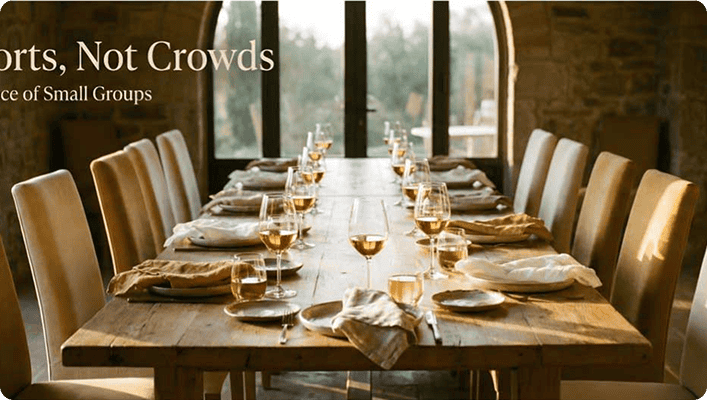
Big crowds make noise.
Small groups make meaning.
In a world built for scale, with bigger audiences, louder launches and longer guest lists, the most interesting shift in luxury is the opposite one. Intimacy is trending up. Scale is trending out.
The Human Limit
Humans are social, but only to a point. Oxford anthropologist Robin Dunbar found that the average person can maintain around 150 meaningful relationships (Oxford University). Within that circle, only 10 to 15 people form the layer of real closeness – the group you actually trust.
Beyond that, attention fragments and empathy thins. The science calls it cognitive overload. We call it small-talk fatigue.
The Sweet Spot for Trust
Studies in cooperation psychology show that groups of 12 to 15 people achieve the highest trust and engagement scores (Oxford Cooperation Study 2024). At that scale, everyone can read subtle cues like tone, timing and warmth – the ingredients that build psychological safety. Once a group passes twenty, data shows a steady decline in contribution and belonging.
It’s why a dinner of twelve feels alive but a banquet of fifty feels like work.
The Chemistry of Connection
The consultancy Chemistry analysed more than 1,000 team sessions and found that small-group formats improved honesty and creativity by 42 percent compared with large sessions (Chemistry’s Small-Group Advantage Report 2025).
When people feel seen, they take risks. When they feel anonymous, they retreat. Trust, not volume, drives participation.
Belonging Scales Back
Private members’ clubs and boutique studios have learned the same lesson. Soho House reports member-retention rates above 80 percent in its smaller Houses compared with 65 percent in larger venues (Company Accounts 2024).
Third Space London notes that classes capped at 12 people score 22 percent higher in satisfaction than open-floor formats (MindBody Survey 2025).
Smaller feels premium because it feels personal.
| Format / Setting | Typical Size | Average Satisfaction Rate | Key Feeling Reported |
|---|---|---|---|
Stadium Concert |
500 + |
62 % |
Energised but detached |
Conference Panel |
100 – 150 |
68 % |
Informed but passive |
Dinner Party |
8 – 12 |
91 % |
Engaged and relaxed |
Boutique Retreat |
12 – 18 |
94 % |
Connected and inspired |
(Sources: Oxford Cooperation Study 2024, Chemistry 2025, MindBody 2025, Soho House 2024)
Why It Matters for Modern Leisure
The rise of community fatigue, constant networks without real connection, has made small-scale experiences feel restorative. People want recognition, not reach.
A curated twelve-person table now signals the same status that a sold-out arena once did.
The Takeaway
Big feels impressive.
Small feels human.
And that is why the future of connection and of luxury belongs to the cohort, not the crowd.