
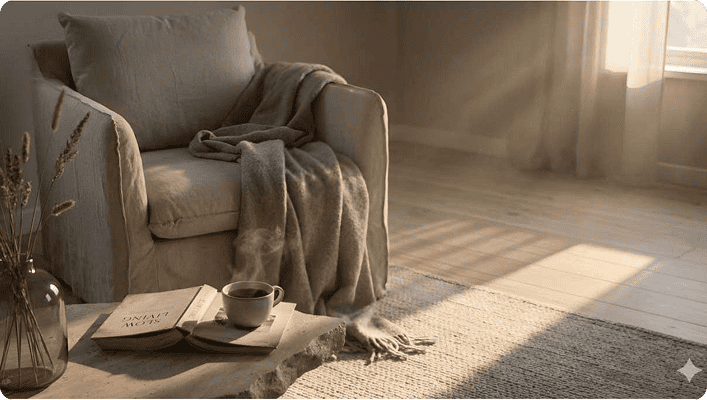
There is a moment, just before dawn or right after everyone leaves the table, when the air itself feels slower.
No alerts. No asks. No need to achieve anything.
It is the rarest luxury left: the feeling of nothing happening.
We have built lives that optimise everything but oxygen. We book recovery like a meeting and then rush through it.
But doing nothing, beautifully, is not absence. It is design.
The Science of Stillness
When we stop, the brain does not power down; it reconfigures.
In that quiet drift of thought, the Default Mode Network switches on, linking memory, emotion, and creativity.
This is when ideas incubate, problems resolve, and our internal stories are written.
Neuroscientists call it wakeful rest, and it is the unsung ingredient behind innovation, empathy, and self-regulation (The Art of Rest: Science & Soul, 2025).
And it is vanishing.
According to Deloitte (2024), 91% of British adults report feeling chronically pressured, and burnout now costs UK employers over £51 billion each year.
In the UK’s four-day-week trial, companies recorded 35% higher revenue and 71% lower burnout, proving that rest is not indulgence, it is infrastructure (The Art of Rest: Science & Soul, 2025).
The Beauty of Biological Design
Every organism on earth is wired for oscillation: exert, release, recover.
The body’s vagus nerve is the conductor of that rhythm, the quiet brake that slows the heart, deepens breath, and restores equilibrium.
When we stare at screens all day, that circuitry never completes its cycle.
We live in permanent “on”, a mode built for survival, not joy.
Doing nothing interrupts that loop.
It teaches the nervous system safety again.
In one Oxford study, even ten minutes of “visual rest” in nature reduced cortisol levels by up to 60 percent (The Art of Rest: Science & Soul, 2025).
The art lies in the how:
not collapse, but calibration.
Soft light. Slow sound. Warm texture.
The Philosophy of Permission
Long before burnout became a KPI, philosophers warned that rest was not a reward; it was the soil of civilisation.
The Dutch call it Niksen, the practice of doing nothing on purpose.
Josef Pieper wrote that leisure is the basis of culture.
Bertrand Russell said idleness is where thought is born.
And yet we stopped resting because someone convinced us that exhaustion looked like ambition.
We began to confuse motion with meaning.
To do nothing, beautifully, is to remember what attention feels like when it is not fractured.
The Modern Reclaim
For London’s high-functioning, high-achieving professionals, stillness has become the final frontier.
The ultimate status symbol is no longer a watch, but a regulated nervous system (Quiet Luxury: Frictionless Leisure Manifesto, 2025).
That is why the culture is turning, from status to sensibility, from excess to ease.
Searches for “quiet luxury travel” and “weekend retreat London” have risen sharply since 2023, and Bain’s 2024 luxury report found that experiential segments now outpace goods by double digits (Quiet Luxury: Frictionless Leisure Manifesto, 2025).
We are learning that what the body really wants is not another long haul, but proximity — a weekend that behaves beautifully.
This is the quiet revolution, the one lit by candlelight, not chaos.
In an economy built on speed, the real rebellion is stillness.
The art of doing nothing, beautifully, is how we begin again.
Drawn to moments. Because not all weekends are created equal.
Copy-ready notes
- Keep paragraph spacing and italics exactly as above for rhythm.
- Font pairing: serif headings, light sans body.
- Suggested SEO tags: quiet luxury, art of rest, weekend retreat UK, burnout recovery, slow travel London.
- Suggested excerpt: “Doing nothing beautifully is not a waste of time. It is how the mind learns to breathe.”